Where Is a USB Stick on Tesla Model 3 and How to Use It
Finding the USB port on a Tesla Model 3 is easy once you know where to look. The main USB port sits in the center console, and a second port hides near the rear cup holders. This guide shows you exactly where is a USB stick on Tesla Model 3, how to set it up, and the best drives to use for music, maps, and media playback.
Have you just bought a Tesla Model 3 and are wondering where to plug in your USB stick? You are not alone. Many new Tesla owners search for where is a USB stick on Tesla Model 3 the moment they get behind the wheel. The good news is that Tesla made it simple to find and use USB ports on the Model 3. In this guide, we will walk you through every detail. You will learn the exact port locations, how to set up your drive, which file types work best, and how to fix common problems. By the end, you will feel confident using your USB stick with your Tesla every single day.
The Tesla Model 3 comes with built-in USB ports that let you play music, view maps, and even charge your phone. However, not all ports work the same way. Some ports are designed for data transfer and media playback, while others are for charging only. Understanding this difference matters. It saves you time and frustration. So let us dive right in and explore everything you need to know about the USB stick on Tesla Model 3.
Key Takeaways
- Two USB ports exist: one in the center console and one near the rear seat area on most Tesla Model 3 builds.
- Use a USB-A drive for older models and USB-C for newer 2021+ Model 3 vehicles.
- Format your drive to FAT32 for the best compatibility with the Tesla touchscreen.
- Supported file formats include MP3, AAC, and MP4 for smooth playback without issues.
- Avoid high-capacity drives over 1TB as the Tesla system may not recognize them properly.
- Keep your USB stick clean and updated to prevent connection problems and media errors.
📑 Table of Contents
Where Is the USB Port on a Tesla Model 3?
Knowing the exact Tesla Model 3 USB port location is the first step. Tesla places the ports in two main spots. Let us break them down for you.
Center Console USB Port
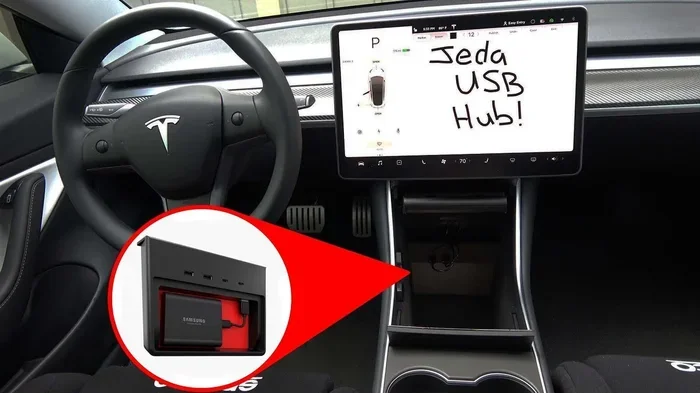
The primary USB port sits inside the center console. This is the main port you will use most often. To find it, open the center armrest lid. Look at the front of the console near the shift lever. You will see a USB-A port there. This port supports both data transfer and charging. It is the best spot for plugging in a USB drive for Tesla Model 3 media playback.
Some Model 3 versions also have a second USB-A port on the front of the center console. This one is closer to the wireless phone charger area. Both ports work for music and files. However, the deeper port inside the armrest is the main media port.
Rear Seat USB Port
If your Tesla Model 3 has rear seat USB ports, you will find them near the rear cup holders. These ports are great for passengers who want to play their own music or charge devices. The rear ports also support data transfer in most cases. However, the touchscreen may not always display rear USB content the same way as the front port. This depends on your Tesla software version.
Not all Model 3 trims include rear USB ports. The Standard Range and Long Range versions may differ. Check your owner’s manual if you are unsure. You can also look behind the rear seat armrest to see if a port is there.
How to Use a USB Stick on Tesla Model 3
Using a USB stick with your Tesla is straightforward. Follow these simple steps to get started.
Step-by-Step Setup
- Plug your USB drive into the center console port. The port is inside the armrest lid.
- Wait for the Tesla touchscreen to recognize the drive. A notification may appear at the top of the screen.
- Tap the Media icon on the bottom toolbar. This opens the media player.
- Select USB as the source. You should see your files listed on screen.
- Browse and play your music or videos. Use the touchscreen to navigate folders and files.
Tips for a Smooth Experience
- Always eject your USB drive properly before removing it. Tap the eject icon on screen.
- Do not unplug the drive while music is actively playing. This can cause glitches.
- Keep your drive in a safe, dry place when not in use.
- If the screen does not recognize the drive, try a different port or restart the Tesla.
Using a Tesla USB media player is one of the easiest ways to enjoy your own music library on the road. You do not need Bluetooth or Wi-Fi. Just plug in and play.
Best USB Sticks for Tesla Model 3
Not all USB drives work equally well with a Tesla Model 3. Choosing the right one makes a big difference. Here are some tips to help you pick the best flash drive for Tesla Model 3.
USB-A vs. USB-C
Older Tesla Model 3 models use USB-A ports. These are the standard rectangular ports you see on most computers. Newer Model 3 vehicles from 2021 onward may include USB-C ports. Check which type your car has before buying a drive.
If your car has USB-C, buy a USB-C drive. If it has USB-A, get a USB-A drive. You can also use an adapter for Tesla Model 3 USB to connect different types of drives. However, adapters can sometimes cause connection issues.
Storage Capacity
Most Tesla owners find that 32GB to 128GB drives work perfectly. These sizes hold thousands of songs and several movies. Drives larger than 1TB may not be recognized by the Tesla system. Keep your capacity moderate for the best results.
Speed Matters
Look for USB 3.0 or USB 3.1 drives. These offer faster read speeds. Music and video files load more quickly when you use a fast drive. A slow drive can cause buffering or lag while playing media on your Tesla touchscreen.
| Drive Type | Best For | Speed | Compatibility |
|---|---|---|---|
| USB-A 3.0 | Music and maps | Fast | All Model 3 versions |
| USB-C | Newer Model 3 (2021+) | Very Fast | 2021+ Model 3 |
| USB-A 2.0 | Basic music playback | Moderate | All Model 3 versions |
| USB with adapter | Mixed port types | Varies | Depends on adapter |
Supported File Formats for Tesla Model 3 USB
The Tesla Model 3 supports specific file formats for media playback. Using the right format ensures smooth operation. Here is what you need to know.
Audio Formats
- MP3: The most widely supported audio format. Works perfectly with Tesla.
- AAC: Another great option for high-quality music files.
- FLAC: Lossless audio format. Tesla supports it on most software versions.
- WAV: Uncompressed audio. Large file size but good quality.
Video Formats
- MP4: The best video format for Tesla Model 3 playback.
- MKV: Sometimes supported but may not work on all software versions.
- AVI: Less reliable. MP4 is always the safer choice.
Always format your USB storage for Tesla Model 3 using the FAT32 file system. This is the most compatible format. Tesla does not support NTFS or exFAT drives reliably. If your drive is not showing up, reformat it to FAT32 and try again.
Common Problems and How to Fix Them
Even with the right drive, you may run into issues. Here are the most common problems with Tesla USB troubleshooting and their solutions.
Drive Not Recognized
If your Tesla does not detect the USB drive, try these steps. First, unplug the drive and plug it back in firmly. Second, try the other USB port in your car. Third, restart your Tesla by holding down both scroll wheels on the steering wheel for about 10 seconds. This clears the system cache and often fixes recognition issues.
Poor Audio Quality
If your music sounds distorted or crackly, the USB drive may be at fault. Try a different drive. Also, check that your files are not corrupted. Low-quality files or damaged drives can cause audio problems. Format the drive again and copy fresh files to it.
Video Will Not Play
Not all video files play on Tesla. Make sure your videos are in MP4 format. If a video still does not play, the file may be too large or use an unsupported codec. Convert the file to MP4 using a free tool like Handbrake before trying again.
Slow File Loading
Slow loading usually means your drive is too slow or too full. Delete unnecessary files to free up space. Also, make sure you are using a USB 3.0 or faster drive. Older USB 2.0 drives transfer data much more slowly.
Expert Tips for the Best USB Experience on Tesla Model 3
Here are some pro tips to get the most out of your USB setup on a Tesla Model 3.
- Label your drive clearly. This helps you identify it quickly when multiple devices are plugged in.
- Keep a backup copy of your music library. USB drives can fail. Always have a backup on your phone or computer.
- Update your Tesla software regularly. New updates often improve USB compatibility and add support for more file types.
- Use short file names. Long file names with special characters can sometimes confuse the Tesla media player.
- Organize files into folders. Create folders for different genres, artists, or playlists. This makes browsing much easier on the touchscreen.
- Avoid extreme temperatures. Do not leave your USB drive in a hot car for long periods. Heat can damage flash memory.
Following these simple tips keeps your Tesla Model 3 media USB setup running smoothly for years. A little care goes a long way.
Conclusion
Now you know exactly where is a USB stick on Tesla Model 3 and how to get the most out of it. The center console port is your main hub for media playback. The rear port adds convenience for passengers. Choose the right drive, format it to FAT32, and use supported file types. These simple steps ensure a seamless experience every time you hit the road.
Using a USB stick with your Tesla Model 3 is one of the best ways to enjoy your personal music library, navigation maps, and media on the go. It is easy, reliable, and works without needing an internet connection. Follow the tips in this guide and you will never have trouble with your USB drive on Tesla Model 3 again. Plug in, play, and enjoy the ride.
Frequently Asked Questions
Can I use any USB stick with my Tesla Model 3?
Most USB sticks work with the Tesla Model 3, but they must be formatted to FAT32 and use supported file types like MP3 for audio or MP4 for video. Avoid drives larger than 1TB for best compatibility with the Tesla system.
Why is my Tesla Model 3 not recognizing my USB drive?
This usually happens because the drive is not formatted correctly, the port is loose, or the software needs a restart. Try unplugging the drive, plugging it back in firmly, or restarting your Tesla by holding both scroll wheels for 10 seconds.
Can I charge my phone using the USB port on a Tesla Model 3?
Yes, the USB ports on the Tesla Model 3 can charge your phone. However, the charging speed may be slower than a dedicated wall charger. The main center console port provides both data transfer and charging power.
What is the difference between the front and rear USB ports on a Tesla Model 3?
The front port in the center console is the primary media port and works for both data and charging. The rear port near the cup holders serves passengers and may have limited display functionality depending on your Tesla software version.
Do I need an adapter to use a USB-C drive on a Tesla Model 3?
Only if your Model 3 has USB-A ports and you want to use a USB-C drive. Newer Model 3 vehicles from 2021 onward may have USB-C ports built in, so no adapter is needed. Using an adapter can sometimes cause connection issues.
How do I safely remove my USB stick from a Tesla Model 3?
Go to the Media screen on your Tesla touchscreen, find the USB source, and tap the eject icon. Wait for the notification that says it is safe to remove before unplugging the drive. This prevents data corruption and file damage.