Here Is How Long It Really Takes to Make a Toyota Car
The time it takes to make a Toyota car typically ranges from 17 to 24 hours on the assembly line. However, the full process from design to finished vehicle can take several months. Toyota’s manufacturing process involves multiple stages, including stamping, welding, painting, and final assembly. Each step plays a critical role in building a reliable and high-quality vehicle.
Have you ever wondered how long it really takes to build a Toyota car? The answer might surprise you. When you sit behind the wheel of a shiny new Toyota, it is easy to forget all the work that went into making it. But the truth is, creating a vehicle is a complex journey with many steps. Toyota car production time depends on several factors, from the model you choose to the factory where it is built. In this article, we will walk you through every stage of the Toyota manufacturing process. You will learn exactly how long each step takes and what makes the whole process tick.
Many people assume cars are built in a day or two. That is not the case. Toyota assembly line operations are carefully planned and timed. Every bolt, every wire, and every panel has a place and a purpose. Understanding this process gives you a new appreciation for the vehicles you drive every day. So let us dive in and explore the fascinating world of automotive manufacturing.
Key Takeaways
- Toyota car production time: Assembly takes 17 to 24 hours per vehicle on the line.
- Full manufacturing cycle: From design to delivery, it can take 3 to 6 months.
- Key stages: Stamping, welding, painting, and final assembly each have specific time requirements.
- Model differences: Some Toyota models take longer to build than others due to complexity.
- Factory location matters: Different Toyota plants around the world have varying production speeds.
- Lean manufacturing: Toyota’s famous system helps reduce waste and speed up the process.
📑 Table of Contents
- The Toyota Manufacturing Process Explained
- How Long Each Stage Takes
- Toyota Car Production Time by Model
- Inside a Toyota Factory
- Factors That Affect Production Time
- Quick Tips for Understanding Toyota Production
- Common Mistakes People Make About Car Production
- Expert Insights on Toyota Manufacturing
- Key Takeaways
- Conclusion
The Toyota Manufacturing Process Explained
The Toyota manufacturing process is one of the most refined systems in the world. Toyota has spent decades perfecting its approach to building cars. This system is known as the Toyota Production System, or TPS. It focuses on efficiency, quality, and reducing waste. Every factory follows a structured path to turn raw materials into a finished vehicle.
The entire journey begins long before any metal is cut. Engineers design the vehicle using advanced software and testing. Once the design is approved, production kicks off. The actual Toyota vehicle build happens on the assembly line. Each station on the line handles a specific task. Workers and robots collaborate to put the car together piece by piece. The whole car manufacturing time from start to finish is impressive when you see it broken down.
Design and Engineering Phase
Before any car hits the factory floor, it starts as an idea. Designers sketch concepts and create digital models. Engineers test every component for safety and performance. This phase alone can take 2 to 3 years for a new Toyota model. During this stage, teams work on the Toyota supply chain to source materials. They choose the best steel, plastics, and electronics. This groundwork is essential for a smooth production later on.
Stamping and Body Construction
Once the design is locked in, stamping begins. Giant presses stamp flat sheets of steel into car body panels. Think of doors, hoods, and roof sections. These parts are shaped with extreme precision. Toyota stamping plant facilities use massive machines to do this work. After stamping, the panels move to the welding station. Here, robots weld the body together. This stage is crucial because it forms the skeleton of the car. A strong body means a safe vehicle.
How Long Each Stage Takes
Now let us break down the actual Toyota production time for each stage. Understanding the timeline helps you appreciate the complexity involved. Each phase has a specific duration, and delays in one area can affect the whole schedule.
Stamping and Welding
The stamping process takes about 3 to 5 minutes per panel. Welding the body shell takes roughly 3 to 4 hours. Robots do most of the welding work. They are fast and incredibly precise. However, quality checks are still done by hand. Workers inspect every weld to make sure it meets Toyota standards. This attention to detail is what sets Toyota apart from many competitors in automotive manufacturing.
Painting and Finishing
After welding, the bare body moves to the paint shop. Painting a car takes about 2 to 3 hours. But it is not just about color. The paint protects the metal from rust and corrosion. Toyota uses a multi-layer paint process. First, the body gets a primer coat. Then comes the base color. Finally, a clear coat is applied for shine and protection. Each layer needs time to dry. The Toyota paint shop is a carefully controlled environment. Temperature and humidity are monitored closely to ensure perfect results.
Final Assembly
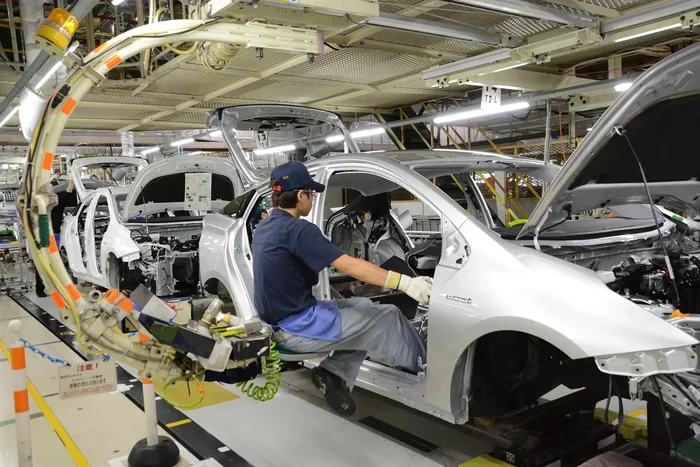
This is where the car truly comes together. The painted body moves to the final assembly line. Here, the engine, transmission, seats, dashboard, and wheels are installed. Final assembly Toyota operations are fast-paced but meticulous. The entire final assembly stage takes about 8 to 12 hours. Every station has a specific task. Workers install the engine, connect wiring, fit the interior, and mount the wheels. At the end of the line, the car undergoes a full quality test.
Toyota Car Production Time by Model
Not all Toyota models take the same amount of time to build. Some vehicles are simpler and faster to assemble. Others have more features and need extra time. Let us look at a few popular models and their estimated build times.
| Toyota Model | Approximate Assembly Time | Complexity Level |
|---|---|---|
| Toyota Corolla | 17 to 20 hours | Standard |
| Toyota Camry | 19 to 22 hours | Moderate |
| Toyota RAV4 | 20 to 23 hours | Moderate-High |
| Toyota Land Cruiser | 22 to 26 hours | High |
| Toyota Tacoma | 18 to 21 hours | Moderate |
| Toyota 4Runner | 21 to 24 hours | High |
As you can see, Toyota model build time varies quite a bit. The Corolla, being a compact sedan, has a simpler build. The Land Cruiser, on the other hand, involves more components and heavier-duty parts. Toyota production line managers adjust the schedule based on the model. This ensures each vehicle gets the attention it needs.
If you are curious about a specific model, the best approach is to check with your local Toyota dealer. They can give you an idea of current production timelines. Keep in mind that global demand also affects how quickly cars are built and delivered.
Inside a Toyota Factory
Walking through a Toyota factory is an experience like no other. The floors are clean and organized. Robots move along rails, carrying heavy parts. Workers wear safety gear and follow strict procedures. Every team member knows their role in the Toyota factory process.
Toyota plants are found in many countries. Major facilities operate in Japan, the United States, Thailand, and Mexico. Each plant follows the same core principles but may have slight differences in speed. For example, a Toyota plant in Kentucky might build trucks faster than one in Japan due to local demand and staffing. But the quality standards remain the same everywhere.
The Toyota assembly line is a marvel of modern engineering. Cars move along the line at a steady pace. They do not stop unless there is a problem. This continuous flow is a key part of lean manufacturing. It keeps Toyota production time efficient and predictable.
The Role of Robots and Humans
Robots handle the heavy and repetitive tasks. They weld, paint, and move heavy parts with ease. But humans are still essential. Workers handle tasks that require judgment and skill. They install delicate electronics, inspect quality, and make real-time decisions. This balance between robots and humans is what makes Toyota factories so efficient.
Quality Checks Throughout the Process
Toyota does not wait until the end to check for problems. Quality inspections happen at every stage. After stamping, after welding, after painting, and during final assembly. If a defect is found, the line stops. This might slow things down briefly, but it prevents bigger problems later. Toyota build cycle quality control is one of the reasons Toyota vehicles last so long.
Factors That Affect Production Time
Several factors can speed up or slow down Toyota car production time. Understanding these helps explain why timelines sometimes vary.
Model complexity: More features mean more time. A basic Toyota Yaris builds faster than a loaded Toyota Tundra.
Factory location: Plants in different countries have different workflows and staffing levels.
Supply chain issues: If parts are delayed, the assembly line slows down. Toyota manages its Toyota supply chain carefully to avoid this.
Global demand: High demand for certain models can create backlogs. Popular trucks and SUVs often have longer wait times.
Seasonal changes: Some factories adjust production based on the season. Winter weather can affect shipping and logistics.
Technology upgrades: When Toyota introduces new technology, workers need training. This can temporarily slow production during the transition.
Each of these factors plays a role in the overall timeline. Toyota works hard to minimize delays and keep production running smoothly.
Quick Tips for Understanding Toyota Production
- Ask your dealer about current wait times. They often have real-time information on production schedules.
- Check the Toyota build and delivery tracker. This tool lets you follow your car’s progress.
- Be flexible with options. Choosing fewer custom features can speed up delivery.
- Understand the supply chain. Global events can affect parts availability and build times.
- Learn about the Toyota Production System. It is the foundation of everything Toyota does.
Common Mistakes People Make About Car Production
Many people underestimate the complexity of building a car. Here are some common misconceptions.
Myth 1: Cars are built in a day. Reality: Assembly takes 17 to 24 hours. The full process takes months.
Myth 2: All Toyota factories work at the same speed. Reality: Production speed varies by location and model.
Myth 3: Robots do everything. Reality: Humans play a vital role in quality and precision tasks.
Myth 4: Production time does not matter. Reality: Understanding timelines helps you plan your purchase better.
Avoiding these misconceptions gives you a clearer picture of what goes into making a Toyota car. It also helps you set realistic expectations when ordering a new vehicle.
Expert Insights on Toyota Manufacturing
Industry experts often praise Toyota’s approach to automotive manufacturing. The Toyota Production System has been studied by manufacturers worldwide. It emphasizes continuous improvement, known as “kaizen” in Japanese. This philosophy means every worker looks for ways to improve their tasks every single day.
Dr. Jeffrey Liker, a professor at the University of Michigan, has written extensively about Toyota’s methods. He notes that Toyota’s focus on process efficiency is unmatched. The company does not just build cars faster. It builds them better. This mindset has made Toyota one of the most respected names in the auto industry.
Lean manufacturing principles are at the heart of everything Toyota does. Waste reduction, just-in-time production, and respect for people are the three pillars. These principles keep Toyota production time lean and efficient. They also ensure that every vehicle meets the highest standards.
Key Takeaways
- Toyota car production time: Assembly takes 17 to 24 hours per vehicle on the line.
- Full manufacturing cycle: From design to delivery, it can take 3 to 6 months.
- Key stages: Stamping, welding, painting, and final assembly each have specific time requirements.
- Model differences: Some Toyota models take longer to build than others due to complexity.
- Factory location matters: Different Toyota plants around the world have varying production speeds.
- Lean manufacturing: Toyota’s famous system helps reduce waste and speed up the process.
- Quality control is constant: Inspections happen at every stage to ensure perfection.
Conclusion
The time it takes to make a Toyota car is a fascinating journey. From the first design sketch to the final quality test, every step matters. Assembly on the line takes 17 to 24 hours, but the full process stretches over several months. Toyota’s commitment to efficiency and quality sets it apart in the world of automotive manufacturing.
Understanding this process gives you a deeper appreciation for every Toyota vehicle. The next time you see a Toyota on the road, you will know the incredible journey it took to get there. Whether you are buying a Corolla or a Land Cruiser, the same care and precision go into every build.
If you are planning to buy a Toyota, keep these timelines in mind. Use the build tracker to follow your car’s progress. And remember, good things take time. Toyota’s careful approach to building vehicles is exactly why they last so long and hold their value so well.
Frequently Asked Questions
How long does it take to build a Toyota car on the assembly line?
On average, it takes 17 to 24 hours to assemble a Toyota vehicle on the production line. The exact time depends on the model and its features. Simpler models like the Corolla build faster, while larger trucks and SUVs take longer.
What is the full timeline from design to delivery for a Toyota car?
The complete process from initial design to final delivery typically takes 3 to 6 months. This includes engineering, prototyping, production, and shipping. Custom orders may take a bit longer depending on options and demand.
Does the Toyota factory location affect production time?
Yes, factory location can affect production speed. Plants in different countries have varying workflows and staffing levels. However, all Toyota factories maintain the same high quality standards regardless of location.
Why do some Toyota models take longer to build than others?
Model complexity is the main factor. Vehicles with more features, larger sizes, or advanced technology require more time on the assembly line. For example, the Land Cruiser involves more components than the Corolla.
What is the Toyota Production System and how does it affect build time?
The Toyota Production System is a lean manufacturing approach that focuses on efficiency and waste reduction. It uses just-in-time production and continuous improvement to streamline the build process. This system helps keep production time optimized without sacrificing quality.
Can I track the production status of my Toyota vehicle?
Yes, Toyota offers a build and delivery tracker on its website. You can use your VIN to follow your vehicle’s progress through production and shipping. This tool gives you real-time updates on where your car is in the process.