How to Measure Exhaust Pipe Diameter for Better Performance
Measuring your exhaust pipe diameter correctly is the first step toward a better-performing vehicle. Whether you are upgrading your exhaust system or replacing a worn-out pipe, getting the right pipe diameter matters a lot. In this guide, we walk you through every method, tool, and tip you need. You will learn how to measure both the inside and outside diameter with confidence and ease.
Your exhaust system plays a huge role in how your engine performs. One small detail makes a big difference: the pipe diameter. If the diameter is too small, your engine chokes. If it is too large, you lose low-end power. That is why knowing how to measure exhaust pipe diameter properly is so important.
Whether you are a DIY mechanic or just someone who wants to understand their vehicle better, this guide has you covered. We will walk you through every step. You will learn the tools you need, the methods to use, and the mistakes to avoid. By the end, you will feel confident measuring any exhaust pipe like a pro.
Key Takeaways
- Use a tape measure or caliper: These are the two most reliable tools for measuring exhaust pipe diameter accurately.
- Measure inside diameter for flow rate: The ID determines how much exhaust gas can move through the pipe.
- Measure outside diameter for fitment: The OD helps you find the right clamps, mufflers, and tips.
- Check the sizing chart: Always cross-reference your measurements with a standard exhaust pipe sizing chart.
- Avoid common mistakes: Measuring only the outer surface or ignoring pipe wall thickness can lead to wrong sizing.
- Match diameter to engine size: The right pipe diameter improves horsepower, torque, and fuel efficiency.
📑 Table of Contents
- Why Exhaust Pipe Diameter Matters for Performance
- Tools You Need to Measure Exhaust Pipe Diameter
- Step-by-Step Guide to Measuring Exhaust Pipe Diameter
- Using an Exhaust Diameter Calculator
- Common Mistakes When Measuring Exhaust Pipe Diameter
- How Pipe Diameter Affects Exhaust Sound and Back Pressure
- When to Upgrade Your Exhaust Pipe Diameter
- Key Takeaways
- Conclusion
Why Exhaust Pipe Diameter Matters for Performance
The diameter of your exhaust pipe controls the speed and volume of exhaust gases leaving the engine. This directly affects your engine’s ability to breathe. A well-sized pipe lets gases flow smoothly. An oversized or undersized pipe creates problems.
How Diameter Affects Exhaust Flow
Think of your exhaust pipe like a straw. A thin straw slows down the drink. A wide straw lets it flow fast. The same idea applies to exhaust gases. When the pipe diameter matches your engine’s output, the gases exit quickly and efficiently. This creates a scavenging effect that helps the engine pull in fresh air and fuel.
Here are the key performance areas affected by pipe diameter:
- Horsepower: The right diameter unlocks more power.
- Torque: Proper sizing improves low-end and mid-range torque.
- Fuel Economy: A correctly sized pipe helps the engine run efficiently.
- Exhaust Sound: Diameter changes the tone and volume of your exhaust note.
- Back Pressure: Too small a pipe increases back pressure. Too large a pipe reduces it too much.
Common Diameter Sizes You Will Encounter
Exhaust pipes come in standard sizes. Most passenger cars use pipes between 2.0 inches and 3.0 inches in diameter. Trucks and larger vehicles may use pipes up to 4.0 inches or more. Performance vehicles often go bigger. Here is a quick look at common sizes:
- 2.0 to 2.25 inches: Common in compact cars and small sedans.
- 2.5 inches: A popular size for mid-size cars and light trucks.
- 3.0 inches: Often found in performance cars and larger trucks.
- 3.5 to 4.0 inches: Typical for heavy-duty trucks and high-performance builds.
Knowing these standard sizes helps you guess the diameter before you even measure. But you should always verify with an actual measurement.
Tools You Need to Measure Exhaust Pipe Diameter
You do not need fancy equipment to get accurate measurements. A few basic tools will do the job perfectly. Let us look at what you need and why each one matters.
Flexible Tape Measure
A flexible tape measure is the easiest tool to start with. You wrap it around the outside of the pipe to get the circumference. Then you divide by pi (3.14159) to find the diameter. This method works great for round pipes. It is simple, fast, and requires no special skills.
Quick Tip: Make sure the tape sits snug against the pipe. Do not let it sag or overlap. A snug fit gives you the most accurate circumference reading.
Digital or Vernier Caliper
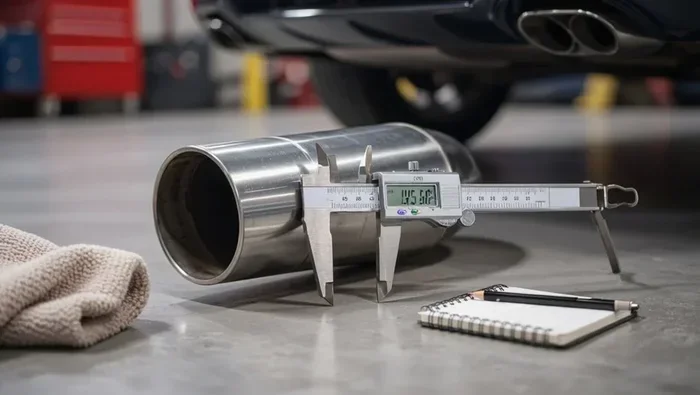
A caliper is the most precise tool for measuring pipe diameter. You can measure both the inside diameter (ID) and outside diameter (OD) directly. Digital calipers give readings in fractions of a millimeter. They are affordable and available at most hardware stores.
Use the caliper jaws to grip the inside of the pipe for the ID. Use the outer jaws for the OD. This gives you two important measurements that tell you the pipe size and wall thickness.
Ruler or Straight Edge
A ruler works in a pinch. You place the straight edge across the pipe opening and measure from edge to edge. This gives you the diameter quickly. However, it is less precise than a caliper, especially for smaller pipes.
Exhaust Pipe Sizing Chart
Once you have your measurement, a sizing chart helps you match it to a standard pipe size. These charts list circumference, diameter, and corresponding pipe sizes. Many online stores and exhaust shops offer free printable charts. Keep one handy when you are shopping for parts.
Step-by-Step Guide to Measuring Exhaust Pipe Diameter
Now let us get into the actual process. Follow these steps carefully to get an accurate reading every time.
Step 1: Find the Pipe Section You Want to Measure
Start by locating the section of pipe you want to measure. This could be the pipe coming off the muffler or the section right before the tailpipe. Make sure the area is cool to the touch. Exhaust pipes get very hot during operation, so always let the engine cool down first.
Clean the pipe surface with a rag. Grease and dirt can make your measurement tools slip. A clean surface gives you better contact and more accurate readings.
Step 2: Measure the Outside Diameter
Place your caliper or ruler across the widest part of the pipe. For a tape measure, wrap it around the pipe and note the circumference. Then divide the circumference by 3.14159 to get the diameter.
Example: If your circumference is 9.42 inches, divide by 3.14159. The result is 3.0 inches. That is your outside diameter.
Step 3: Measure the Inside Diameter
The inside diameter is just as important as the outside diameter. Use the caliper’s inner jaws to measure across the hollow center of the pipe. This measurement tells you the actual flow area of the pipe.
Subtract twice the wall thickness from the outside diameter to check your ID measurement. If the numbers match, your measurement is likely correct.
Step 4: Measure the Pipe Wall Thickness
Wall thickness matters when you are shopping for replacement pipes or upgrades. Use the caliper to measure from the outer edge to the inner edge of the pipe wall. Standard wall thickness for exhaust pipes ranges from 0.035 inches to 0.065 inches for most passenger vehicles.
Thicker walls mean more durability but less flexibility during bending. Thinner walls are lighter but may dent more easily.
Step 5: Record and Compare Your Measurements
Write down all your measurements. Note the OD, ID, circumference, and wall thickness. Now compare these numbers to a standard exhaust pipe sizing chart. This confirms the pipe size and helps you find compatible parts.
Quick Tip: Take at least three measurements at different points around the pipe. Pipes are not always perfectly round. Taking multiple readings gives you an average that is more accurate.
Using an Exhaust Diameter Calculator
If math is not your strong suit, an exhaust diameter calculator is a great alternative. These online tools do all the work for you. You enter your engine displacement, RPM range, and desired exhaust flow. The calculator suggests the ideal pipe diameter.
How to Use a Calculator Effectively
First, find your engine displacement. This is usually listed in your vehicle owner’s manual. Next, determine your target RPM range. Higher RPM engines generally need larger diameter pipes. Lower RPM engines perform better with smaller diameters.
Enter these values into the calculator. It will give you a recommended pipe diameter in inches or millimeters. Use this as a starting point. Then verify with a physical measurement of your current pipe.
Expert Insight: A good rule of thumb is 1.5 to 2.0 square inches of pipe area per cylinder. For a four-cylinder engine, that means a pipe diameter of about 2.0 to 2.5 inches. This is a starting point, not a final answer. Always measure your actual pipe to confirm.
Common Mistakes When Measuring Exhaust Pipe Diameter
Even experienced car owners make mistakes when measuring. Here are the most common errors and how to avoid them.
Measuring Only the Outer Surface
Some people measure only the outside of the pipe and assume that is the diameter that matters for performance. The inside diameter is what controls exhaust flow. Always measure both the ID and OD for a complete picture.
Ignoring Pipe Wall Thickness
Wall thickness affects the strength and weight of the pipe. It also matters when you are welding or fabricating custom exhaust components. Ignoring this measurement can lead to parts that do not fit properly.
Measuring a Bent or Damaged Section
Never measure a section of pipe that is dented, bent, or corroded. These sections give false readings. Find a straight, undamaged section of the pipe for the most accurate measurement.
Guessing Instead of Measuring
Many people guess the pipe diameter based on the exhaust tip size. The tip size is often larger than the actual pipe diameter. Always measure the pipe itself, not the tip. A 3.0-inch tip may cover a 2.5-inch pipe.
Using the Wrong Units
Mixing up inches and millimeters is a common mistake. Make sure your measuring tool and your reference chart use the same units. Convert if necessary before comparing measurements.
How Pipe Diameter Affects Exhaust Sound and Back Pressure
The diameter of your exhaust pipe changes more than just performance. It also changes the sound of your vehicle and the level of back pressure in the system.
Understanding Back Pressure
Back pressure is the resistance exhaust gases face as they leave the engine. A pipe that is too small creates high back pressure. This forces the engine to work harder to push out gases. The result is lost power and reduced efficiency.
A pipe that is too large creates very low back pressure. While this sounds good, it can actually hurt performance at low RPMs. The exhaust gases move too fast and lose energy. This reduces the scavenging effect that helps the engine breathe.
The Sound Factor
Larger diameter pipes produce a deeper, louder exhaust note. Smaller pipes create a higher-pitched sound. Many car enthusiasts choose pipe diameter based on the sound they want. But the diameter should always be matched to engine size first. Sound is a bonus, not the primary factor.
Quick Tip: If you want a deeper sound without losing performance, consider a resonator or muffler with a larger diameter pipe. This gives you the tone you want without sacrificing flow.
When to Upgrade Your Exhaust Pipe Diameter
Not every vehicle needs a larger exhaust pipe. But certain situations call for an upgrade. Knowing when to change your pipe diameter can save you time and money.
Signs You Need a Larger Pipe
- Your engine feels sluggish at high RPMs.
- You have added a turbocharger or supercharger.
- You have upgraded your engine with larger cylinders or more displacement.
- You notice excessive back pressure during hard acceleration.
- Your current pipe is rusted, corroded, or damaged.
Signs Your Current Size Is Fine
- Your engine has strong power across the RPM range.
- You have not made major engine modifications.
- Your exhaust sounds balanced and not overly loud.
- Your fuel economy is normal or better than expected.
When in doubt, measure your current pipe and compare it to a sizing chart for your engine type. This gives you a clear answer.
Key Takeaways
- Measure both ID and OD: The inside diameter controls flow, and the outside diameter helps with fitment.
- Use the right tools: A caliper gives the most accurate readings, while a tape measure works well for quick checks.
- Take multiple measurements: Pipes are not perfectly round, so average your readings for the best result.
- Use a sizing chart: Always cross-reference your measurements with a standard chart to confirm the pipe size.
- Match diameter to engine size: The right pipe diameter improves horsepower, torque, and fuel efficiency.
- Avoid guessing: Never rely on the exhaust tip size or visual estimates. Always measure the pipe directly.
- Consider wall thickness: This affects durability, weight, and compatibility with other exhaust components.
Conclusion
Measuring exhaust pipe diameter is a simple task that makes a huge difference. Whether you are building a performance exhaust or replacing a worn-out section, getting the right diameter is essential. The right pipe size improves your engine’s breathing, boosts power, and can even save fuel.
Use the tools and methods we covered in this guide. Measure the inside diameter, outside diameter, and wall thickness. Cross-check with a sizing chart. And if you are unsure, use an exhaust diameter calculator as a starting point. These steps ensure you always get the right pipe size for your vehicle.
Now you know how to measure exhaust pipe diameter with confidence. Grab your tools, pop the hood, and get measuring. Your engine will thank you for it.
Frequently Asked Questions
What is the easiest way to measure exhaust pipe diameter?
The easiest way is to use a flexible tape measure. Wrap it around the pipe to get the circumference, then divide by 3.14159 to find the diameter. This method works well for round pipes and requires no special tools.
Does exhaust pipe diameter affect engine performance?
Yes, it does. The pipe diameter controls how fast exhaust gases flow out of the engine. A properly sized pipe improves horsepower, torque, and fuel efficiency. An incorrectly sized pipe can hurt performance in one or more of these areas.
Should I measure the inside or outside diameter of the exhaust pipe?
You should measure both. The inside diameter determines exhaust flow rate, while the outside diameter helps with fitment of clamps, mufflers, and tips. For performance tuning, the inside diameter is the more critical measurement.
Can I use an exhaust pipe sizing chart instead of measuring?
A sizing chart is a helpful reference, but it should not replace an actual measurement. Charts give you standard sizes, but your pipe may be worn, modified, or non-standard. Always measure to confirm the exact size.
What happens if my exhaust pipe is too small?
An undersized pipe creates high back pressure. This forces the engine to work harder to expel exhaust gases. The result is lost power, reduced fuel economy, and potential engine damage over time.
How do I know what diameter exhaust pipe I need for my car?
Start by measuring your current pipe diameter. Then compare it to a standard sizing chart for your engine displacement. You can also use an online exhaust diameter calculator. Enter your engine details and it will suggest the ideal pipe size for your application.