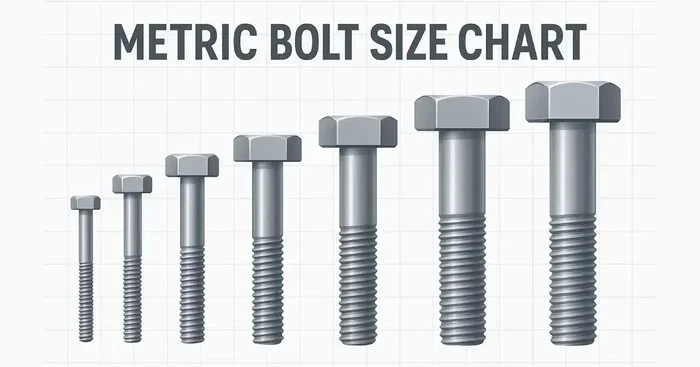
Difference Between M5 and M8 Which Size Is Right for You
The difference between M5 and M8 bolts comes down to diameter, strength, and application. M5 fasteners measure 5mm across while M8 bolts measure 8mm, making them suited for very different jobs. Choosing the right size ensures your project stays safe, strong, and built to last. This guide breaks down everything you need to know.
If you have ever stood in front of a bolt bin and wondered which one to grab, you are not alone. The difference between M5 and M8 bolts might seem small on paper, but it makes a huge difference in real-world projects. M5 and M8 are both metric fasteners, yet they serve very different roles. One handles delicate electronics, while the other anchors heavy machinery.
Choosing the wrong size can mean a loose joint, a broken project, or even a safety hazard. That is why understanding these two common bolt sizes matters so much. In this guide, we will walk through every important detail. By the end, you will know exactly which size to pick for your next job.
Key Takeaways
- M5 bolts are smaller: They measure 5mm in thread diameter and work best for light-duty tasks.
- M8 bolts are larger: At 8mm diameter, they handle heavier loads and tougher jobs.
- Thread pitch matters: M5 uses a finer thread while M8 uses a coarser thread, affecting how they grip materials.
- Load capacity differs: M8 bolts can handle significantly more weight than M5 bolts.
- Project type dictates choice: Electronics and small assemblies need M5, while construction and automotive work often requires M8.
- Always check your manual: Using the wrong size can lead to failure or damage.
- Both are metric fasteners: They follow the same metric thread system but serve different purposes.
📑 Table of Contents
- What Does M5 and M8 Mean?
- M5 vs M8: Head-to-Head Comparison
- When to Use an M5 Bolt
- When to Use an M8 Bolt
- M5 and M8 Bolt Sizes and Dimensions
- Bolt Grades and Strength Comparison
- Common Mistakes to Avoid
- How to Choose the Right Size for Your Project
- Expert Tips for Working with Metric Fasteners
- Conclusion
What Does M5 and M8 Mean?
The “M” stands for metric. It tells you the bolt follows the metric thread system. The number that follows is the outer diameter of the thread in millimeters. So an M5 bolt has a 5mm diameter, and an M8 bolt has an 8mm diameter. Simple, right?
But there is more to it than just the diameter. The thread pitch also matters. This is the distance between each thread ridge. M5 bolts have a finer pitch of 0.8mm. M8 bolts use a coarser pitch of 1.25mm. This difference affects how the bolt grips into materials and how much force it can handle.
Why Thread Pitch Matters
Finer threads like those on an M5 bolt give you more threads per millimeter. This means a tighter grip in soft materials like wood or plastic. Coarser threads on an M8 bolt are better for hard materials like steel. They also allow for faster installation and easier adjustment.
Here is a quick look at the basic specs:
- M5 bolt: 5mm diameter, 0.8mm thread pitch
- M8 bolt: 8mm diameter, 1.25mm thread pitch
- M5 screw size: Smaller head, lighter load
- M8 screw size: Larger head, heavier load
M5 vs M8: Head-to-Head Comparison
Let us put these two side by side. This comparison table shows the key differences between the two bolt sizes:
| Feature | M5 Bolt | M8 Bolt |
|---|---|---|
| Diameter | 5mm | 8mm |
| Thread Pitch | 0.8mm | 1.25mm |
| Typical Length Range | 5mm to 50mm | 10mm to 100mm |
| Common Head Types | Pan, flat, hex | Hex, socket, flange |
| Load Capacity (approx.) | Low to medium | Medium to high |
| Common Uses | Electronics, furniture, bikes | Automotive, construction, machinery |
| Wrench Size Needed | 8mm | 13mm |
As you can see, the difference between M5 and M8 goes well beyond just the number. Each size has its own strengths and ideal use cases. Let us dig deeper into where each one shines.
When to Use an M5 Bolt
The M5 bolt size is perfect for lighter applications. If you are working on something small and precise, M5 is likely your best bet. These bolts are everywhere in everyday items you touch.
Common M5 Applications
Here are some places where you will typically find M5 fasteners at work:
- Electronics and circuit boards: M5 bolts hold components in place without adding too much weight or bulk.
- Furniture assembly: Many flat-pack desks and shelves use M5 screws for panel connections.
- Bicycles: Frame bolts, seat post clamps, and brake mounts often use M5 hardware.
- Appliances: Small household appliances rely on M5 bolts for their outer casings.
- Model building and robotics: Precision projects love the smaller diameter of M5 fasteners.
The M5 bolt gives you enough holding power for these tasks without being oversized. It is also easier to work with in tight spaces where a large bolt simply will not fit.
M5 Bolt Strengths and Limitations
Every fastener has trade-offs. The M5 screw is easy to install and fits into small assemblies. However, it cannot handle heavy loads. If you try to use an M5 bolt where an M8 is needed, the bolt may shear or strip out under pressure.
Quick Tip: Always check the tensile strength rating of your M5 bolt. Grade 8.8 is common for standard use, while Grade 12.9 offers higher strength for demanding applications.
When to Use an M8 Bolt
The M8 bolt steps up to a much heavier class of work. When you need real holding power, this is the size you reach for. The M8 bolt dimensions make it a go-to choice in construction and automotive work.
Common M8 Applications
Here is where M8 fasteners really prove their value:
- Automotive engines and frames: M8 bolts secure engine components, suspension parts, and body panels.
- Construction and structural work: Steel frames, scaffolding, and heavy equipment use M8 bolts regularly.
- Machinery and industrial equipment: Large machines depend on M8 fasteners for assembly and maintenance.
- Marine and outdoor projects: Boats and outdoor furniture benefit from the stronger grip of M8 hardware.
- Electrical panels: Heavy-duty electrical enclosures often require M8 bolts for secure mounting.
The M8 screw provides a much larger contact area with the material. This means better distribution of force and a more secure hold. For projects where safety and durability matter most, M8 is the clear winner.
M8 Bolt Strengths and Limitations
The main strength of an M8 bolt is its load capacity. It can handle forces that would easily destroy an M5 bolt. However, it is also bulkier. You need bigger tools, more space, and often more torque to install it properly.
Quick Tip: Use a torque wrench when tightening M8 bolts. Over-tightening can strip threads, while under-tightening can lead to loose joints.
M5 and M8 Bolt Sizes and Dimensions
Understanding the exact M5 bolt dimensions and M8 bolt dimensions helps you choose the right hardware every time. Let us break down the key measurements you need to know.
M5 Bolt Dimensions at a Glance
- Nominal diameter: 5mm
- Thread pitch: 0.8mm (fine)
- Wrench size: 8mm
- Typical head width: 8mm (hex head)
- Common lengths: 5mm, 10mm, 15mm, 20mm, 25mm, 30mm
M8 Bolt Dimensions at a Glance
- Nominal diameter: 8mm
- Thread pitch: 1.25mm (coarse)
- Wrench size: 13mm
- Typical head width: 13mm (hex head)
- Common lengths: 10mm, 15mm, 20mm, 25mm, 30mm, 40mm, 50mm
The bolt head size difference is significant. You cannot swap an M5 nut for an M8 nut. They will not fit. Always double-check your measurements before purchasing fasteners for a project.
Bolt Grades and Strength Comparison
Not all bolts are created equal, even within the same size. Bolt grades tell you how much force the fastener can withstand before it breaks. Both M5 and M8 bolts come in multiple grades.
Common Bolt Grades
- Grade 4.6: Low strength, suitable for light-duty applications
- Grade 8.8: Medium strength, the most common grade for general use
- Grade 10.9: High strength, often used in automotive and engineering
- Grade 12.9: Very high strength, ideal for the most demanding jobs
An M8 bolt in Grade 12.9 can handle far more force than an M5 bolt in Grade 8.8. This is an important consideration when planning any mechanical project or engineering application. Always match the bolt grade to the demands of your project.
Expert Insight: When in doubt, go one grade higher than you think you need. It costs a little more but gives you a much bigger safety margin. This is especially true for M8 bolts used in structural applications.
Common Mistakes to Avoid
Even experienced builders make mistakes with bolt sizing. Here are the most common errors and how to avoid them:
Mixing Up Metric and Imperial Sizes
An M5 bolt is not the same as a 5/16 inch bolt. They look similar but have different thread pitches. Always confirm you are buying metric fasteners when your project calls for them. Mixing systems can lead to stripped threads and unsafe joints.
Ignoring Thread Pitch
Some people only look at diameter and forget about pitch. An M5 bolt with a coarse thread will not fit properly into a hole designed for a standard M5 pitch. Always match both the diameter and the pitch for a secure fit.
Underestimating Load Requirements
Using an M5 bolt in a high-load situation is a recipe for failure. The difference between M5 and M8 load capacity is substantial. If your project involves vibration, movement, or heavy weight, step up to M8 or larger.
Over-Tightening
More torque does not mean a better connection. Over-tightening an M5 bolt can snap it clean off. Over-tightening an M8 bolt can strip the threads in the material. Use a torque guide or your tool’s settings to apply the right amount of force.
How to Choose the Right Size for Your Project
Still not sure which bolt you need? Follow these simple steps to make the right call.
- Check your project manual or design plans. The manufacturer will usually specify the exact bolt size required.
- Consider the material you are joining. Soft materials like wood can use smaller bolts. Hard materials like steel may need larger ones for proper grip.
- Evaluate the load and stress factors. Light-duty items like shelves work fine with M5. Heavy-duty items like engine mounts need M8.
- Think about the available space. Tight spaces favor M5 bolts. Open areas can easily accommodate M8 bolts.
- Match the bolt grade to the application. Safety-critical projects need higher-grade fasteners regardless of size.
When you follow these steps, choosing between M5 and M8 becomes much simpler. You will feel confident in your selection every time.
Expert Tips for Working with Metric Fasteners
Here are some practical tips from experienced builders and engineers:
- Keep a bolt gauge on hand. It helps you quickly identify bolt sizes on the spot.
- Use thread-locking compound. This prevents bolts from loosening due to vibration, especially on M8 fasteners.
- Label your fastener bins. Mixing up M5 and M8 bolts in a shared workshop causes confusion and wasted time.
- Buy extra bolts. It is always better to have too many than too few. Having spares saves trips to the hardware store.
- Inspect bolts before use. Check for rust, damage, or stripped threads. A damaged bolt will not perform as expected.
Quick Tip: A fastener size chart is one of the most useful tools you can have in your workshop. Print one out and keep it near your workbench. It saves time and prevents costly mistakes.
Conclusion
The difference between M5 and M8 bolts comes down to size, strength, and application. M5 bolts are your go-to for lighter, precision-based work. M8 bolts bring the muscle needed for heavy-duty projects. Both are essential metric fasteners, but they serve very different roles in the world of construction, engineering, and DIY projects.
Now that you understand the key differences, you can make confident choices for your next build. Check the specifications, consider the load, and always match the bolt to the job. With the right M5 bolt or M8 bolt in hand, your project will be built to last.
Grab your wrench, pick the right size, and get to work. Your project will thank you for it.
Frequently Asked Questions
What is the main difference between M5 and M8 bolts?
The main difference is the diameter. An M5 bolt measures 5mm across the threads, while an M8 bolt measures 8mm. This size difference affects the load capacity, the tools needed, and the types of projects each bolt is best suited for.
Can I use an M5 bolt instead of an M8 bolt?
You should not substitute an M5 bolt for an M8 bolt in most cases. The M5 bolt is smaller and weaker, and it may fail under loads designed for an M8 bolt. Always use the size specified in your project plans to ensure safety and structural integrity.
What does the M stand for in M5 and M8 bolts?
The M stands for metric. It indicates that the bolt follows the international metric thread standard. The number after the M represents the outer diameter of the bolt thread in millimeters, so M5 is 5mm and M8 is 8mm.
Are M5 and M8 bolts interchangeable?
No, M5 and M8 bolts are not interchangeable. They have different diameters, different thread pitches, and different wrench sizes. Using the wrong size can damage your materials, weaken the joint, or create a safety hazard in your project.
Which bolt size is stronger, M5 or M8?
The M8 bolt is significantly stronger than the M5 bolt. Its larger diameter and greater thread engagement allow it to handle much higher loads and forces. For heavy-duty applications like automotive or construction work, M8 is the clear choice for strength.
What tools do I need for M5 and M8 bolts?
For M5 bolts, you need an 8mm wrench or spanner. For M8 bolts, you need a 13mm wrench or spanner. Using the correct wrench size prevents rounding the bolt head and ensures you can apply the right amount of torque without damaging the fastener.
=== CONCLUSION ===
The difference between M5 and M8 is clear once you understand the basics. M5 bolts handle light-duty work with precision, while M8 bolts deliver the strength needed for heavy applications. Both sizes play important roles in construction, automotive repair, and DIY projects around the home.
Remember to always check your project requirements before buying bolts. Match the size, grade, and type to the job at hand. With the right fastener in hand, you build with confidence and create something that lasts. Pick the right size, and your project will be strong, safe, and ready for anything.